

Chris Hancock on The SAF Podcast
Our CEO, Chris Hancock, joined Oscar Henderson on The SAF Podcast to discuss the future of aviation and the role Avioxx is playing in making low-cost sustainable fuel a reality. As debate about decarbonising flight accelerates, the need for affordable SAF is becoming increasingly clear.
You can listen to the full discussion on our website or via SAF Investor on any podcast streaming platform.
“We do not accept that SAF has to cost $3,000 to $5,000 per tonne. Our job is to prove a different path.”
Chris Hancock
Introductions
Oscar: Welcome to the latest episode of The SAF Podcast. I’m delighted to be joined today by Chris Hancock from Avioxx.
Chris: Thanks very much for the invitation. I am looking forward to discussing what we are building at Avioxx.
Oscar: To start, can you tell listeners a little about your background and how you came into the SAF sector?
Chris: I trained as an environmental engineer at the University of Nottingham, then moved into technology and software where I built and exited a venture-backed fintech company. After that, I wanted to reconnect with my environmental grounding and work on something that directly addresses the climate emergency.
From fintech to clean tech
Oscar: What similarities and differences have you noticed between fintech and clean tech?
Chris: Clean tech today reminds me of fintech after the global financial crisis. There was a real urgency to stabilise and modernise the financial system. Back in 2012 fintech was very young, with small agile companies working alongside major banks to create new products.
Synthetic and sustainable fuel production feels similarly early-stage but full of potential. You have established incumbents, strong regulation and big infrastructure, and at the same time a new generation of companies trying to show there is a better way to do things.
What Avioxx does and why it is different
Oscar: What is Avioxx’s proposition in terms of feedstock, technology pathway and target market?
Chris: Avioxx aims to produce high-quality synthetic fuel at a lower cost than fossil kerosene.
At our pilot facility in Cheshire, supported by advanced modelling tools such as AspenTech, we have shown that our patented process can reach price parity with fossil jet fuel at scale.
We use established technologies such as gasification and Fischer–Tropsch reactors, but we combine them with a key innovation. We integrate a solid oxide fuel cell directly into the process, which allows us to generate electricity internally. Most SAF pathways rely on significant electricity purchases from the grid, which is expensive in the UK. Designing a system that produces its own electricity removes a major operating cost.
Cost savings and waste feedstock
Oscar: How significant are the savings from self-generating electricity?
Chris: Electricity is usually the largest operating cost for SAF producers. Our second major advantage is our choice of feedstock. We use refuse-derived fuel and in many cases, we are paid to take it. That gives us an additional revenue stream and helps address the global waste problem.
When we model a commercial-scale plant, including the extra capital expenditure for the SOFCs, we see a potential reduction of around 80 per cent in electricity costs.
NIRAS is our engineering and construction partner, and we are supported by Hulteberg chemistry and engineering in Sweden.
We believe this can be delivered. There will be risks to manage, but our philosophy is that innovation – not accepting SAF at $3,000 to $5,000 per tonne – is the way to address climate, energy security and waste within a circular economy.
Digital infrastructure and AI
Oscar: You are doing extensive modelling before construction. Can you explain what this involves and why it matters?
Chris: With two decades in software, we have built Avioxx as a digital-first business. That brings benefits to design, implementation, operations and measurement.
We are working with companies such as AVEVA in Cambridge, which provides established digital control and modelling tools for refineries. At our Runcorn facility, both the control system and the lab infrastructure use machine learning and AI. This allows us to analyse large volumes of reactor data quickly and cost-effectively, identify anomalies and optimise conditions.
AI is there to support engineering judgement, not replace it. All outputs, whether generated by people or AI, go through quality assurance, peer review and internal challenge.
Why focus on the UK?
Oscar: Your development plans are centred around the UK. Why is that?
Chris: We are a UK-founded business with a British corporate investor, and we see a strong need for greater energy self-sufficiency here. At present there is only one operating plant producing synthetic fuel at scale in the UK, so there is a clear opportunity.
The three founders are from the north-west, a region with deep chemical engineering heritage. Stanlow refinery is there, the second largest in the country, and Cheshire has a long industrial history. There is even a Second World War legacy, where engineers in the region created higher-performance fuels that gave Spitfires an advantage.
Supporting and modernising that region is important to us and developing synthetic crude there is a natural first step.
The three-step scale-up plan
Oscar: Let’s talk about your scale-up strategy. You have designed three different refineries. What are they and what is the timeline?
Chris: Our scale-up follows three clear steps.
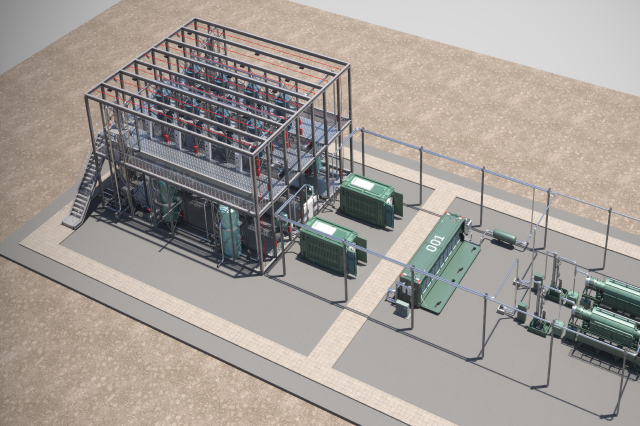
- Small modular plant – 600 tonnes per annum
Produces around 2 tonnes of fuel per day
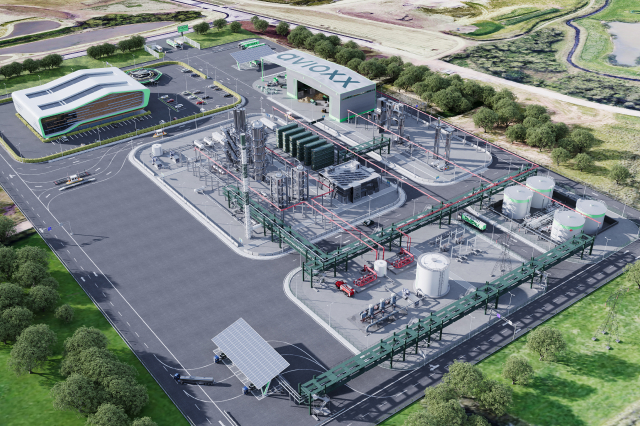
Modular and mobile, roughly the size of a football pitch
Suitable for airport sites, islands or landfills, turning local waste into synthetic crude
Demonstrates industrial-scale production
Ready to begin construction once our Series A round closes – we already have partners in place and a permitted site in Cheshire - Medium plant – 5,000 tonnes per annum of SAF
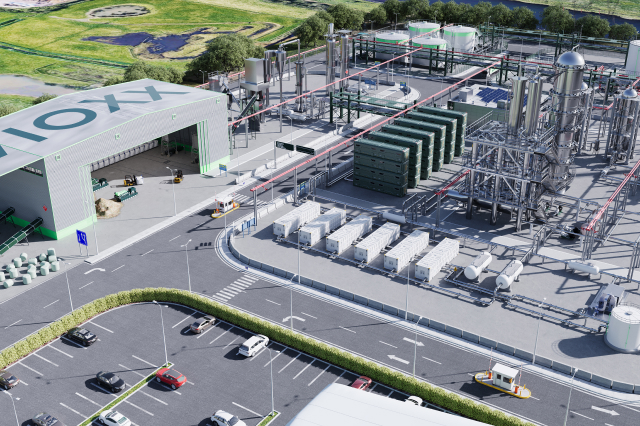
Produces 5,000 tonnes of SAF each year plus around 8,000 tonnes of e-diesel and e-gasoline
Footprint of around 20 acres, processing roughly 50,000 tonnes of waste per year
Fully off-grid and includes integrated carbon capture, removing around 90 per cent of process CO₂
A north-west UK location allows for future connection to the HyNet CO₂ infrastructure
Target start date is around 2027 with an estimated two-year build - Commercial plant – 32,000 tonnes per annum of SAF
First-of-a-kind full-scale facility
Produces SAF, e-diesel and e-gasoline
Processes around 300,000 tonnes of waste each year
Designed to operate without external electricity or hydrogen
Aims to be operating by 2030, in line with the UK’s 10 per cent SAF mandate
The bigger picture here is that climate urgency, combined with incoming SAF mandates, is creating a real market in the UK and Europe. That is what drives the rationale for our step-by-step scale-up.
Funding strategy: Trailfinders, Series A and beyond
Oscar: Let’s look at the funding side. You received a pre-Series A round from Trailfinders. Tell us about that and what comes next.
Chris: We completed our seed round a couple of years ago, followed by a pre-Series A last year led by Trailfinders. They are an excellent strategic investor. As one of the largest independent travel companies in the UK, they bring strong industry insight.
They also have deep relationships with airlines around the world, which has already helped us significantly in developing offtake discussions.
We are now raising a Series A round of roughly 13 million dollars to develop and build our first small modular demonstration plant.
The ambition is not simply to build a single first-of-a-kind plant. It is to create a global standard for off-grid synthetic and sustainable fuel production. I am a strong believer in strategic investment. The more value an investor can add, whether through networks, brand, credibility or technical expertise, the better.
Government, grants and policy
Oscar: How do you view the Government’s role, including grants, the SAF mandate and the revenue certainty mechanism?
Chris: We are privately funded and believe the sector ultimately needs to operate without relying on subsidies. The total capital deployed through programmes like the Advanced Fuels Fund is helpful but still small compared with what the industry requires overall.
We do, however, work closely with the Department for Transport on fuel testing and certification. Funding in that programme goes directly to the external laboratories that test our fuel, not to Avioxx, but the collaboration is important.
We are also working with the UK SAF Clearing House to test our fuel against ASTM standards and ensure it is fully compliant. They validate what we are producing from a regulatory perspective, rather than us simply stating that our fuel meets the standard.
Overall, our interaction with Government is focused on compliance and policy rather than capital support. From our point of view, effective policy is far more important than grants. The SAF mandate, the revenue certainty mechanism, sustainability rules such as ISCC and the carbon accounting and trading frameworks are what will create a genuine market that private capital can support.